Watching a dog perform an elaborate, front-to-back stretch that mirrors a professional yoga session is a charming part of the morning routine. Most owners view it as a simple, cute habit, yet they often feel a twinge of worry when the dog starts stretching excessively or “bowing” at strange times during the day. This confusion leads to missed medical warnings or a failure to recognize a dog’s desperate attempt to communicate their social intentions.
The definitive reason dogs stretch like humans is to engage in pandiculation, which physically prepares their muscles and joints for immediate movement by flooding them with fresh oxygen and blood. The biggest takeaway is that stretching is a biological “system reboot” that resets the internal muscle-length receptors, ensuring the dog is ready to jump, run, or defend itself. Beyond physical maintenance, stretching acts as a highly evolved “social lubricant,” used to signal playfulness or to politely diffuse a stressful encounter with a stranger.
The Canine Stretching Overview: Mind Map
- Physiological Reset: Increasing blood flow and flushing out metabolic waste after deep sleep or long naps.
- The Greeting Stretch: A social display used to communicate trust and a lack of aggression toward humans or other pets.
- The Play Bow: A specific “invite” to initiate high-energy wrestling or chasing games.
- Medical Indicators: Differentiating between healthy pandiculation and the “prayer position” caused by intense abdominal pain.
The Biology of Pandiculation: The Body’s System Reboot
Humans often reach for the ceiling and yawn right after the alarm goes off, and dogs follow a nearly identical biological script. During sleep, muscles naturally tighten and blood flow to the extremities slightly decreases as the body focuses on internal repair. Stretching—scientifically called pandiculation—is the involuntary response that wakes up the sensory-motor system.
When a dog stretches their front paws out far and pushes their chest to the floor, they are physically lengthening the fascia and connective tissues. This action sends a clear signal to the brain to “re-calibrate” the tension levels in the muscles. It ensures that when the dog decides to chase a squirrel five minutes later, their tendons are elastic and their joints are properly lubricated.
🚨 Vet Fact: Puppies and senior dogs often stretch more frequently than healthy adults. Growing puppies stretch to accommodate rapidly lengthening bones and muscles, while senior dogs utilize frequent stretching to manually alleviate the joint stiffness associated with early-stage osteoarthritis.
Advanced Insight 1: The “Greeting Stretch” as a Social Signal
Generic pet articles often miss the social nuance of the “Greeting Stretch.” If a dog wakes up from a nap and immediately performs a long stretch specifically when their owner walks into the room, it is rarely just about muscle maintenance. This is a deliberate “calming signal” designed to show the human that the dog is relaxed, non-threatening, and happy to see them.
In the wild, a sudden, fast movement from a resting predator could be interpreted as an attack. By performing a slow, deliberate stretch, a dog is physically demonstrating that their “engine” is just starting up. It is a biological way of saying, “I am not a threat, and I am totally comfortable in your presence.”
Consider the case of a rescued Greyhound in Pennsylvania that would never approach visitors directly. Instead, the dog would stand ten feet away and perform a deep, exaggerated front-leg stretch while making eye contact. The owners realized this wasn’t just a physical need; it was the dog’s way of “introducing” themselves politely without the pressure of direct physical contact.
Advanced Insight 2: The Sploot and Hip Maintenance
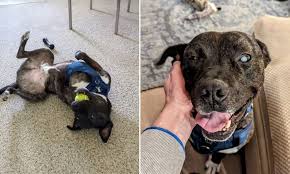
Owners of Corgis, Bulldogs, and Pit Bulls are intimately familiar with the “sploot”—where the dog lies flat on their belly with their hind legs kicked out straight behind them like a frog. While this looks comically human-like, it serves a technical orthopedic purpose. The sploot provides a deep stretch to the hip flexors and allows for maximum surface area contact with a cool floor.
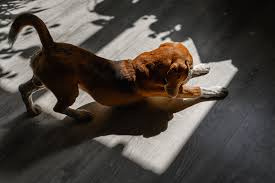
For heavy-muscled breeds, the sploot is the most effective way to decompress the lower spine and pelvis. It allows the dog to “off-load” their body weight entirely, giving the hip joints a total break from gravitational pressure. If a dog only sploots on cold tile, they are likely using the stretch to regulate their core temperature while simultaneously resting their joints.
🐾 Snoutbit Pro-Tip: If a dog suddenly stops “splooting” or seems to have difficulty extending their hind legs backward, it may indicate a loss of flexibility in the hips. Monitor their ability to rise from a lying position, as this change can be an early indicator of hip dysplasia or soft tissue inflammation.
Advanced Insight 3: The Danger of the “Prayer Position”
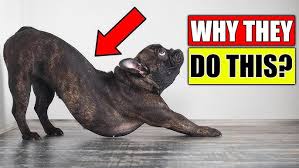
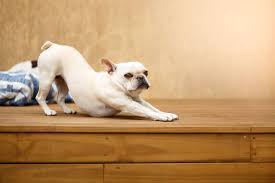
There is a critical, life-saving distinction between a healthy stretch and the “prayer position.” In a healthy play bow or morning stretch, the dog is fluid, happy, and usually transitions into another movement quickly. In the prayer position, the dog keeps their front legs down and their rear end up for prolonged periods, often with a stiff, “tucked” abdomen and a worried facial expression.
This is a clinical sign of acute abdominal pain. The dog is stretching the muscles around their stomach to relieve the pressure of internal gas, bloating, or even a foreign object blockage. Unlike a normal stretch, a dog in the prayer position will often appear lethargic, refuse treats, or pant heavily while holding the pose.
Take the anecdotal reality of a young Boxer in Ohio that began “stretching” repeatedly after a large holiday meal. The owners initially thought the dog was just being goofy, but noticed the dog held the bow for nearly two minutes while staring at their own stomach. Because they recognized this wasn’t a standard stretch, they rushed the dog to the emergency vet, where a life-threatening “bloat” (GDV) was caught just in time.
🚨 Vet Fact: Canine Gastric Dilatation-Volvulus (GDV) is a catastrophic medical emergency where the stomach twists. The prayer position is one of the most common “silent” warning signs that the dog is experiencing extreme internal pressure.
Why Dogs Stretch Before Play
The famous “Play Bow” is perhaps the most recognizable stretch in the canine vocabulary. This is a highly specific “meta-communication” tool that tells other dogs (and humans), “Everything I am about to do next is just a game.” It re-contextualizes potentially aggressive behaviors—like growling, nipping, or lunging—into safe, social play.
When a dog bows, they are putting themselves in a physically vulnerable position. By lowering their head and chest, they are showing their partner that they are not a threat. It is the canine equivalent of a boxer touching gloves before a match; it sets the rules and ensures everyone stays on the same page.
Environmental Triggers: The Carpet Connection
Dogs frequently choose specific surfaces for their most intense stretches. Carpets and rugs provide the necessary traction for a dog to “dig in” their claws and pull against the fabric, much like a human using a yoga mat for stability. This resistance allows them to achieve a much deeper stretch in the shoulders and spine.
If a dog is constantly stretching against the sofa or the side of the bed, they are likely looking for extra leverage to reach deep muscle fibers. Providing a variety of non-slip surfaces throughout the home ensures the dog can safely perform their daily pandiculation without slipping and causing a muscle strain.
🐾 Snoutbit Pro-Tip: Watch the dog’s paws during a deep stretch. If they “knead” or flex their toes against the floor, they are stimulating the nerve endings in their paw pads. This is a sign of a high-quality, full-body sensory reset that helps the dog feel grounded and alert.
What To Do Next
- Perform a “Stretch Audit” Today: Observe the dog the next time they wake up from a long nap. Meticulously note if they stretch both the front and back legs evenly; a dog that consistently avoids stretching one specific limb may be masking a hidden injury or localized joint pain.
- Learn the 10-Second Rule: If the dog assumes a bowing position, count to ten. A healthy stretch or play bow almost always resolves within a few seconds as the dog moves on to a new activity. If the dog holds the position for longer than ten seconds while appearing distressed or “frozen,” contact a veterinarian immediately to rule out an abdominal emergency.
Disclaimer: The content on Snoutbit.com is for informational and educational purposes only and is not intended to replace professional veterinary advice, diagnosis, or treatment. Always consult with your veterinarian before making significant changes to your dog’s diet, exercise routine, or health regimen.