Key Takeaways
- The Chemistry of Panic: Canines can physically smell the massive spikes in human stress hormones during an acute, life-threatening emergency.
- Breaking Instincts: For an untrained companion dog to leave their bonded owner to seek help requires overcoming massive, deeply ingrained biological survival instincts.
- The Silent Killer: Hypothermia acts incredibly fast, making the rapid, intuitive response of a frantic dog the only deciding factor between life and death.
The freezing autumn rain violently turned the backyard dirt into a slick, inescapable trap of deep mud. The heavy, motorized wheelchair’s tires spun uselessly for a fraction of a second before the entire three-hundred-pound machine violently tipped backward. He hit the freezing ground incredibly hard, the massive steel frame pinning his paralyzed legs completely underneath its crushing weight.
The icy water immediately began seeping through his thin jacket, chilling him to the bone in the desolate, empty yard. He couldn’t reach his dropped cell phone, and his desperate, panicked shouts were entirely swallowed by the roaring wind. As the freezing mud began to slowly swallow his legs, he realized with absolute terror that nobody was coming to save him.
A Desperate Fight Against the Freezing Mud
His knuckles turned stark white as he desperately clawed at the slick, freezing earth, trying to drag his upper body free. The sheer mechanical weight of the inverted wheelchair was entirely immovable, acting as a brutal, steel anchor against his trapped lower half. With every frantic, exhausted struggle, the chair seemed to sink deeper into the saturated ground, pressing heavily against his chest cavity.
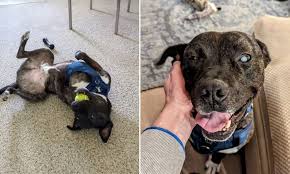
A few yards away, his rescue dog, a scruffy terrier mix named Buster, completely stopped sniffing the wet perimeter fence. Buster’s ears pinned flat against his wet skull, and his entire body went rigidly tense at the horrifying sight of his owner on the ground. He let out a sharp, high-pitched bark of pure distress, instantly abandoning his favorite chew toy in the soaking grass.
Buster sprinted directly to his owner’s side, his paws sinking deeply into the treacherous, icy mud. He didn’t offer a playful nudge or a relaxed tail wag, behaviors typical of a dog misunderstanding a human simply playing on the ground. Buster immediately began frantically digging at the thick mud underneath the heavy steel wheels, his raw instincts desperately trying to unearth his trapped human.
The Chemistry of Canine Panic
The dog’s dark, expressive eyes were dilated with sheer, unadulterated terror as he aggressively clawed at the unyielding metal frame. He wasn’t simply reacting to the visual anomaly of the tipped wheelchair; he was actively smelling the sudden, massive spike of human cortisol. When a human experiences sheer panic, their sweat glands rapidly excrete stress hormones that act as a glaring chemical alarm bell to a canine’s hyper-sensitive olfactory system.
Buster let out a series of low, shuddering whines, pressing his wet snout forcefully against his owner’s freezing, trembling cheek. He was exhibiting a profound behavioral response known as frantic appeasement, desperately licking the man’s face to check for vital signs and consciousness. The dog’s own heart rate violently skyrocketed, perfectly mirroring the intense physiological terror of his paralyzed, trapped companion.
The man weakly wrapped his freezing fingers into Buster’s coarse, wet fur, relying on the dog’s radiating body heat to fight off the creeping numbness. Hypothermia is an incredibly insidious, quiet killer, rapidly pulling life-saving warmth away from the body’s vital internal organs. As the man’s core temperature dangerously plummeted, his vision began to blur, and his desperate calls for help faded into a weak, barely audible rasp.
Snoutbit Tip: Understanding Emotional Contagion in Canines
What is Emotional Contagion? Emotional contagion is a highly documented psychological phenomenon where dogs entirely absorb and mirror the emotional and physiological state of their human handlers. This is not simply a trained response; it is a deep, hardwired evolutionary survival mechanism that kept ancestral packs alive.
How It Manifests in Emergencies: When an owner is severely injured or terrified, a dog will often display extreme acute stress signals right alongside them. These include excessive lip licking, violent trembling, frantic pacing, and highly distressed, high-pitched vocalizations. The dog physically feels the owner’s blinding panic as if they are in direct, mortal danger themselves.
The Rescue Instinct: Unlike formally trained service dogs who execute specific, practiced commands during a medical crisis, untrained companion dogs rely entirely on raw intuition. This intense empathetic bond is what drives a completely untrained shelter dog to perform complex, life-saving rescue maneuvers when their owner is facing imminent death.
Breaking the Proximity Barrier
As the icy rain relentlessly battered them both, Buster made a profound, incredibly difficult psychological choice. A domestic dog’s absolute strongest survival instinct is to stay in close physical proximity to their bonded human during a terrifying crisis. Leaving the side of a dying owner goes against every single fiber of their deeply ingrained pack mentality.
However, Buster inherently understood that his frantic digging was completely useless against the massive, immovable weight of the motorized wheelchair. He gave his fading owner one last, desperate lick on the forehead before suddenly turning toward the distant property line. He violently scrambled up the muddy embankment, slipping and sliding as he sprinted furiously toward the quiet, deserted rural road.
Buster threw his entire fifteen-pound body against the wooden perimeter gate, aggressively squeezing through a tiny, splintered gap in the heavy fence boards. He didn’t stop to sniff the unfamiliar asphalt or cautiously check for oncoming vehicles in the blinding, heavy rain. He sprinted directly into the exact center of the road, placing himself in extreme physical danger to act as a desperate, living roadblock.
The Flashing Lights of Survival
A passing delivery driver almost slammed on his heavy anti-lock brakes when a tiny, mud-soaked terrier darted violently into his headlights. Buster didn’t cower or run away from the massive, idling truck; he stood his absolute ground, barking with a frantic, deafening intensity. He aggressively lunged at the driver’s side door, repeatedly turning his head back toward the dark, flooded property.
The driver instantly recognized the severe, unnatural urgency in the dog’s panicked body language and immediately stepped out of his warm cab. Buster let out a sharp yelp and instantly darted back through the broken fence, constantly checking to ensure the tall stranger was following him. He expertly navigated the treacherous, flooded yard, leading the deeply confused driver directly to the terrifying scene in the back paddock.
The driver gasped in pure horror upon finding the paralyzed man entirely pinned under the heavy chair, his skin a terrifying, pale shade of blue. He immediately dialed emergency services, desperately using his own dry work jacket to cover the freezing, entirely unresponsive victim. Throughout the entire agonizing wait for the paramedics, Buster remained fiercely wedged against his owner’s chest, absolutely refusing to let anyone separate them.
An Unbreakable Bond Forged in the Freezing Mud
The deafening wail of the approaching ambulance sirens finally pierced the quiet, heavy tension of the rural property. It took three strong paramedics to physically heave the massive steel wheelchair off the man’s crushed, freezing legs. He was immediately rushed to the intensive care unit, suffering from severe clinical hypothermia and dangerous muscular crush injuries.
If Buster had stayed by his side instead of bravely breaking his proximity instinct to seek out a stranger, the medical team confirmed the man would not have survived the night. The tiny, untrained rescue dog had successfully executed a highly complex, multi-step rescue maneuver fueled entirely by absolute devotion. He had traded the immediate safety of the pack to gamble heavily on the kindness of a complete stranger.
Today, the man is safely back home, navigating the wet yard with a vastly heightened sense of immense gratitude. Buster never strays more than a few feet away from the heavy wheels of the newly repaired motorized chair. He is no longer just a scruffy shelter rescue; he is a certified, fierce guardian angel permanently wrapped in a muddy, terrier coat.
FAQ: Canine Behavior During Medical Emergencies
Do dogs actually know when humans are severely injured? Yes, absolutely. Dogs have an incredibly advanced olfactory system that can literally smell the sudden chemical changes in a human body, such as massive cortisol spikes or rapidly dropping blood sugar levels. Combined with their expert ability to read incredibly subtle human body language, they instantly recognize when their owner is physically incapacitated.
Why do some untrained dogs run away during an emergency? Not all dogs possess the sheer confidence or the deep emotional resilience to handle a sudden, terrifying crisis. Severe trauma can cause a timid dog to enter a state of blind panic, triggering their biological “flight” response and causing them to flee the overwhelming environment entirely. This is a highly natural biological reaction and never an indicator that the dog does not deeply love their owner.
Can I train my family pet to fetch help in a crisis? While you can absolutely teach a domestic dog to fetch a specific item like an emergency medical bag indoors, teaching them to independently leave the property to find a stranger is incredibly dangerous. True, reliable emergency response requires thousands of hours of elite, professional service dog training to ensure the dog does not get fatally injured in traffic while attempting to seek help.
Disclaimer: The content on Snoutbit.com is for informational and educational purposes only and is not intended to replace professional veterinary advice, diagnosis, or treatment. Always consult with your veterinarian before making significant changes to your dog’s diet, exercise routine, or health regimen.