Closing the bathroom door for two minutes of guaranteed peace seems entirely reasonable for any exhausted pet parent. Suddenly, a heavy paw aggressively slides under the doorframe, followed immediately by desperate whining and frantic scratching against the wood. This relentless invasion of personal space creates immense daily frustration, leaving handlers completely baffled by the dog’s obsessive shadowing and apparent lack of household boundaries.

The definitive solution requires recognizing this exact behavior as a brilliant survival instinct rather than a stubborn behavioral flaw. Dogs follow humans to the bathroom strictly to act as an active, defensive lookout during a highly vulnerable biological process. They are essentially returning the exact same protective favor they expect when locking eyes with a handler during their own outdoor bathroom breaks.
Canine Shadowing: Overview Mind Map
- Vulnerability Guarding: Protecting a highly valued pack member during a biologically compromised, entirely defenseless moment.
- Captive Audience Conditioning: Seeking guaranteed, uninterrupted physical affection while the human is completely stationary.
- Olfactory Investigation: Analyzing the massive concentration of fascinating chemical scents heavily amplified by shower humidity.
- Clinical Separation Panic: Displaying highly destructive scratching and severe physical distress when completely separated by a solid barrier.
Advanced Insight 1: The Vulnerability Guarding Instinct
In the brutal reality of the wild, animals are never more physically vulnerable to a lethal ambush than when actively eliminating waste. Wild canids survive by implementing a strict, highly organized buddy system, establishing a 360-degree perimeter of defense around the compromised pack member. When a domestic dog forces their way into a tiny half-bath, they are perfectly executing this ancient, deeply ingrained security protocol.
The dog is not actively trying to be annoying or dominant; they are performing a high-stakes, highly serious security detail. By sitting directly facing the closed bathroom door, the dog is actively watching the perimeter for incoming environmental threats. Punishing a dog for this specific behavior heavily confuses the animal, as they truly believe they are successfully performing a crucial household job.
🚨 Vet Fact: Canines biologically synchronize their daily routines with their primary handlers, leading to perfectly matched circadian rhythms. When a human walks toward the bathroom immediately after waking up, the dog’s brain frequently registers this exact motion as the official biological start of the morning pack activity.
Advanced Insight 2: The Captive Audience Trap
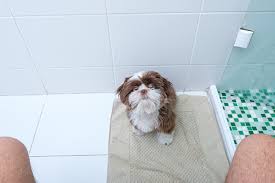
Elite trainers easily recognize that humans accidentally, yet incredibly efficiently, train their dogs to become obsessive bathroom shadows. When a person sits entirely stationary on the toilet, they frequently reach down to casually pet the dog waiting at their feet. This simple action creates a massive, highly predictable behavioral reinforcement loop officially known as the “Captive Audience Trap.”
The highly intelligent canine brain quickly calculates that the bathroom is the absolute only room where the human is physically trapped and completely undistracted. The human is not holding a laptop, washing heavy dishes, or rushing out the front door. The dog learns that physically pushing into the bathroom permanently guarantees a solid three minutes of highly focused, premium physical affection.
Breaking this frustrating cycle requires absolute, unwavering physical boundaries and immense consistency. If the dog is allowed inside the bathroom, handlers must completely ignore them, offering absolutely zero eye contact and zero physical touch. Once the bathroom stops functioning as an incredibly reliable petting zoo, the dog’s urgent, frantic desire to visit will naturally begin to fade.
The “Velcro Breed” Phenomenon
Certain specific canine bloodlines were selectively bred for hundreds of years to work in extremely tight, constant proximity to their human handlers. Herding breeds like Australian Shepherds and sporting breeds like German Shorthaired Pointers possess a massive genetic drive to shadow every single human movement. For these specific “Velcro breeds,” a closed interior door represents an incredibly confusing break in the established working protocol.
Consider the reality of a highly driven Vizsla living in a busy, chaotic suburban household. The dog would frantically pace and violently vocalize every single time the owner attempted to take a closed-door shower. The owners finally placed a designated, highly comfortable dog bed directly inside the safest corner of the master bathroom.
By providing a specific, trained “place” command, the Vizsla felt successfully integrated into the morning routine without pacing frantically. The dog was successfully able to fulfill its genetic shadowing requirement while remaining safely out of the immediate splash zone. Working alongside genetics is always infinitely more successful than aggressively fighting against centuries of selective breeding.
🐾 Snoutbit Pro-Tip: To instantly decrease bathroom shadowing, provide the dog with a highly engaging, frozen puzzle toy in the kitchen exactly two minutes before taking a shower. This effectively redirects their high-value focus onto a long-lasting food reward, naturally teaching them that remaining entirely outside the bathroom is significantly more profitable.
Advanced Insight 3: The High-Value Olfactory Zone
Humans rely heavily on visual input, but the advanced canine brain maps the entire physical world through incredibly complex chemical scent processing. To a highly sensitive dog, the household bathroom represents the absolute most fascinating olfactory environment in the entire house. The tiny room holds an incredibly dense, trapped concentration of the owner’s unique, heavily concentrated biological pheromones.
Furthermore, the massive influx of steam and heavy humidity generated during a hot shower acts as a massive olfactory amplifier. Moisture physically traps scent particles in the air, allowing the dog’s vomeronasal organ to process the complex data with incredible, high-definition clarity. The dog is essentially reading a highly detailed, chemical newspaper strictly regarding the owner’s current health and emotional state.
Preventing access to this fascinating scent data can cause intense frustration for naturally curious, high-drive tracking dogs. Allowing the dog to perform a quick, ten-second visual and olfactory sweep of the empty bathroom before closing the door often satisfies this intense biological curiosity. Once the room is fully deemed safe and thoroughly investigated, the dog is significantly more likely to walk away voluntarily.
Distinguishing Shadowing from Separation Anxiety
A critical diagnostic distinction must absolutely be made between harmless biological shadowing and severe, clinical separation anxiety. A completely healthy dog will calmly lie down outside the closed bathroom door, patiently waiting for the handler to naturally reappear. If the dog wanders off to inspect a random noise in the kitchen, their shadowing behavior is entirely healthy, normal, and strictly voluntary.
Conversely, a dog suffering from massive separation panic will experience an immediate cortisol spike the exact second the barrier closes. This physically manifests as destructive scratching at the doorframe, highly frantic panting, and distressed, high-pitched howling. The dog is not guarding the owner; they are actively experiencing a terrifying, involuntary panic attack directly triggered by the sudden loss of visual contact.
Take the terrifying case of a rescued Weimaraner that literally chewed entirely through a hollow-core bathroom door in under ten minutes. The owners mistakenly assumed the highly destructive dog was simply acting incredibly stubborn and dominant. True separation distress requires intense, methodical desensitization protocols and frequently necessitates professional veterinary intervention to successfully lower the animal’s baseline panic levels.
🚨 Vet Fact: Sudden, completely uncharacteristic clinginess in a senior dog is frequently a silent, highly ignored indicator of rapid vision or hearing loss. If an older dog suddenly refuses to let the handler out of their direct sight, schedule a thorough geriatric veterinary exam to firmly rule out advancing sensory deficits or hidden cognitive dysfunction.
Establishing Healthy Bathroom Boundaries
Handlers possess complete authority to firmly establish perfectly healthy physical boundaries without causing the dog any emotional distress whatsoever. Teaching a dog to comfortably wait outside the bathroom effectively builds essential, foundational household impulse control. This vital behavioral skill effortlessly translates to other critical safety boundaries, like actively preventing dangerous door-dashing at the front entryway.
Start by securely utilizing a standard, heavy-duty baby gate placed directly across the open bathroom doorway. The dog completely maintains critical visual and olfactory contact with the handler, completely preventing any sudden, unexpected isolation panic. Toss high-value, premium treats entirely over the gate to heavily reward the dog for sitting calmly on the opposite side of the threshold.
Gradually transition to partially closing the solid wooden door while continuously dispensing the premium rewards completely underneath the gap. This slow, methodical progression clearly teaches the dog that the bathroom door closing predicts highly positive, delicious environmental outcomes. Over time, the dog completely loses the frantic urge to breach the room, opting instead to wait patiently and calmly for their guaranteed reward.
What To Do Next
- Execute the “Boring Bathroom” Protocol: Starting today, completely eliminate all eye contact, verbal praise, and physical petting whenever the dog successfully enters the bathroom. Stripping the specific environment of all high-value social rewards instantly and dramatically decreases the room’s overall psychological appeal to the dog.
- Install a Temporary Visual Barrier: Place a sturdy, reliable baby gate across the bathroom threshold precisely before taking the next scheduled shower. This simple barrier perfectly allows the dog to fulfill their genetic instinct to “guard” the pack perimeter while successfully keeping them entirely out of the immediate physical space.
Disclaimer: The content on Snoutbit.com is for informational and educational purposes only and is not intended to replace professional veterinary advice, diagnosis, or treatment. Always consult with your veterinarian before making significant changes to your dog’s diet, exercise routine, or health regimen.